
What Are The Processing Steps Involved in Making Tomato Sauce?
Tomato sauce is a very common condiment indeed, used in home cooking as well as in the food service and fast food sectors. It's generally made from tomato paste (the base ingredient) with water added, blended, heated, homogenised and then sterilised. It's a sauce which is of a consistency and flavour which is quite suitable for direct consumption as opposed to tomato paste.
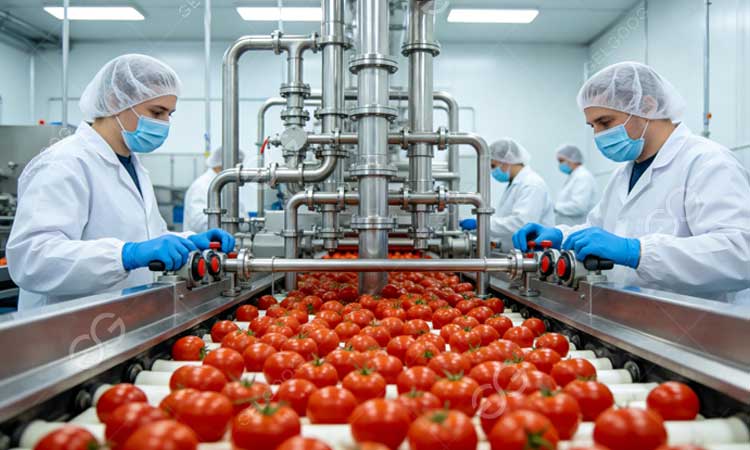
So what are the processing steps involved in making tomato sauce?
The process of making tomato sauce will vary from one product to the next depending on the recipe, the required viscosity, the packaging and the required shelf life. The general process is as follows:
Tomato paste → Raw material inspection → Dilution and mixing → Addition of ingredients and seasoning → Heating and homogenisation → Deaeration (optional) → Sterilisation → Filling and sealing → Cooling and inspection → Final packaging.
1. Inspection of tomato paste raw material
Tomato paste is the basic raw material for the manufacture of tomato sauces and the quality of the paste will have a direct bearing on the colour, flavour, viscosity and stability of the finished product.
Prior to production the tomato paste must be checked for solids, colour, aroma, acidity and microbiological parameters to ensure it meets all the relevant food safety requirements.
2. Dilution and blending of tomato paste
Tomato paste as a concentrated product will have a high solids content and a very thick texture which may not be suitable for all tomato products. It will therefore need to be diluted to the correct concentration and viscosity for the particular product. The required amount of paste and the required amount of water (as defined by the product formula) are added to the equipment and continuously agitated to ensure that it is properly blended and to avoid any areas of excessive thickness or the formation of lumps.
3. Addition of ingredients and seasoning
The diluted tomato paste needs further seasoning to get the right texture and flavour for the finished product.
Commonly added ingredients include:
- Sugar: to adjust the sweetness and balance the acidity of the tomatoes.
- Salt: to bring out the flavour of the tomatoes and enhance the overall taste.
- Vinegar or other acidulants: to adjust the acidity in accordance with the recipe and to meet the food safety control requirements.
- Spices and seasonings: things like onion powder, garlic powder, pepper and the like to give the product a particular flavour.
- Thickeners/stabilisers: Included in some formulations to provide viscosity and ensure stability over storage.
Ingredients are generally fed into the blending tank via a metering system and then mixed thoroughly to ensure all the components are properly blended.
4. Heating and Homogenization
Once the ingredients have been added the tomato sauce is then subjected to further heat treatment and, if required, homogenisation.
The main purpose of heating is to ensure the ingredients are fully dissolved and mixed and to establish the correct conditions for the ensuing sterilisation.
Homogenisation is used to improve the texture and consistency of the product. For a tomato sauce which is intended to be smooth and have a stable appearance, appropriate homogenisation equipment (selected on the basis of the particular recipe) can be used to achieve a more uniform product structure.
5. Deaeration
During the stirring and mixing phases a certain amount of air will be entrained in the tomato sauce. If this air is not properly handled it can have a negative effect on filling accuracy, on the product's appearance and on the product's quality in storage.
For products where appearance and storage stability are of a high order a vacuum deaeration stage can be included to remove the air bubbles and dissolved gases.
6. Sterilization
Sterilisation is a key step in the industrial production of tomato ketchup, having a direct bearing on the microbiological safety and shelf life of the product.
Manufacturers can choose the appropriate sterilisation method depending on the product's acidity, formulation, packaging and the conditions in which it will be stored.
7. Filling and Sealing
After sterilisation the tomato sauce goes to filling. The choice of food grade packaging will vary according to the market and the product. This could be in glass bottles, plastic bottles, flexible pouches and so on.
8. Cooling, inspection and finished product packaging
Following filling and sealing the product will require appropriate cooling or other post processing in accordance with the particular heat treatment method used. The rate and method of cooling will be dictated by the heat resistance of the packaging materials, the product processing requirements and the required microbiological controls.
The finished products are then sampled and inspected to assess such things as appearance, colour, flavour, viscosity, net content, packaging, and the relevant microbiological parameters. Where the product is intended to be stored at ambient temperature it is also necessary to confirm that the shelf life and storage conditions have been validated.
Once they've passed inspection they go on to labelling, coding, cartoning, palletising and then either go into storage or are dispatched.
The fundamental element of tomato sauce is high quality, consistent tomato paste which is then processed through the tomato sauce processing lines to produce a safe, flavour consistent product that meets the market's requirements.